

Should Rewards Help Raise Readers? (Article #39)
Yes, but not for the reasons you think.

Since the early 1970s, studies have explored the impact of external rewards on children’s intrinsic motivation at school and on the home front. Some of the research suggests that external rewards, especially when expected and used to control behavior, can diminish intrinsic motivation over time, particularly for activities children already enjoy. More recent research reframes these earlier findings, suggesting the reward’s type, purpose, and delivery play a role in its effectiveness.
Specifically, praise based on the process rather than the outcome itself tends to have the most positive impact on intrinsic motivation; therefore, rather than simply praising the child for an A on a test, adults may better encourage future motivation by praising the child’s effort, persistence, or study strategies instead.
I conducted a cursory look into the research behind external rewards and their connection to intrinsic motivation because I planned to advocate for the power of external rewards on motivating my daughter’s reading habit, and for most of this article, it will appear that this is exactly what I am doing, but hang with me to the end here because there is a larger point I plan to make.
With my daughter’s birthday approaching, conversations have already turned to gift wish lists, and one set of grandparents has asked whether or not they can replace my child’s original kid-friendly iPad from years ago with an adult version. I am torn by the request because I already battle enough screens for my child’s attention, but I also recognize I only have so much will power to fight off technology in this age of parenting.
As a result, I expressed my concerns about another screen in the house with my daughter, particularly addressing the recent lack of reading I was seeing at home. Highly motivated to earn an iPad “because all her friends have one,” she proposed a 30-day challenge. She would read 20 minutes every day for the next 30 days without fail. In exchange, I promised to take a 30-day jump roping challenge in which I would jump rope with her every day for five minutes. You can read more about why this jump roping challenge is important to my daughter’s reading journey in Article #37 “For the Book Lovers Whose Children Do Not Love Books As Much As They Do.”
She especially loves Reading Bingo cards often given out by educators to help students find joy in the reading process when on extended breaks from school. The Reading Bingo cards suggest different ways to read, such as “Read in a fort,” “Read under a tree,” or “Read to a pet.” You get the idea. Of her own volition, then, my daughter printed out a May calendar and filled each day with a reading activity. So far, she has stuck with it.
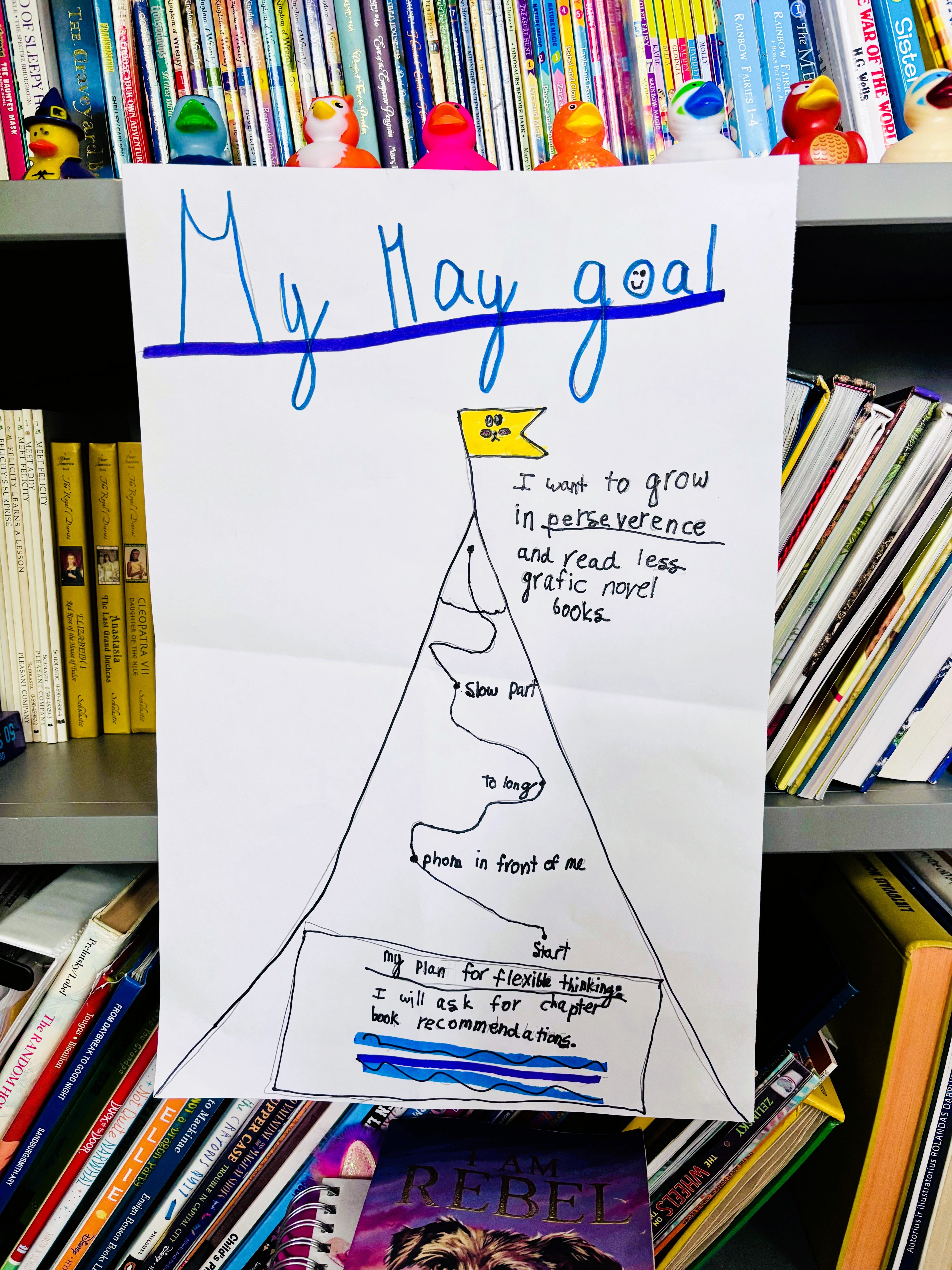
Within the same week of creating this calendar, my daughter brought home a poster from school and was excited to share its contents with me. During a lesson on perseverance, the students were asked to create a “goal mountain” visualization. Along the path to the mountain top, students incorporated three anticipated obstacles they might encounter before reaching the peak– the goal. My daughter’s goal revolved around reading more chapter books, overcoming screen-time allures and not giving up on books that felt too long or had too many slow parts.
So far, it’s been a classic that has captured and maintained my daughter’s attention again– book two in the Nancy Drew series. Specifically, she chose it because she has seen the 2019 version starring Sophia Lillis in Nancy Drew and the Hidden Staircase, and while this is a modern adaptation, my daughter often references her memories of it when attempting to understand some of the more difficult plot elements– those often grounded in legal conflicts.
My daughter’s motivation to set reading goals began during second grade with Battle of the Books. You can read more about that adventure in Article #4 “Battle of the Books: A Battle for Reading.” Specifically, she liked the competitive nature of the reading journey. She liked adding a sticker to her team’s progress chart at school with each book she completed. She liked knowing the answers at the trivia battles. She loved earning a spot in the championship game, and when her team only placed third with her winning four free cake slices at Portillo’s, my husband and I made sure to take the hike to one (as there isn’t one that close to us) to trade them in for the prize.
During the second half of second grade, my daughter’s reading tutor set a reading goal for her and said once achieved, she’d meet my daughter at a bookstore to select a book. My daughter was motivated, and she earned that book just in time for our local library’s Summer Reading Program.
Over the summer, as children reach certain reading milestones, they earn badges for a lanyard, a free book from the library, ice cream certificates at McDonald’s and then at Oberweis, a free meal at a local burger joint, a free pass to a roller skating rink, a free ticket to a minor league baseball game, and so forth. Motivated to keep my daughter engaged with reading, I made sure we used every single reward she earned through the library’s summer reading program, and so my daughter loved tracking her reading minutes, picking up her prizes, and celebrating her reading victories.
Recently, I heard on the news that Pizza Hut is rebranding its Book It! Program from a more school-based initiative to a family-focused one. You can read more about it at bookitprogram.com.
I remember the program from childhood. When I achieved a reading goal at my school, I received a certificate I could turn in at my local Pizza Hut for a free personalized pan pizza. Frankly, I thought the program no longer existed, so I am glad to find out it’s still around with a push to make it more culturally visible again. After all, I have fond memories of my family going on Friday nights to our dimly lit Pizza Hut with the red vinyl booths, so I could get my very own small pizza served in my very own deep dish pan. Don’t you?
I applaud companies, like Pizza Hut, that promote reading by offering its products and services as incentives. It makes reading visible, valued, community-oriented, and just plain fun even if some people cringe at the use of commercialized extrinsic rewards.
But let’s rewind here and relook at the examples I have given so far about using rewards to motivate a child to read. On closer examination, it isn’t really about the reward at all.
I can’t tell you how many minutes or what books I read to earn the Pizza Hut pizza, but those childhood outings conjure happy memories of time spent with my family who was celebrating something I accomplished. I hope when my child looks back at all the times we went out to redeem an earned reading reward, she will remember these moments in a similar fashion.
The rewards, then, are just the physical manifestation of adults celebrating– through relationship-building experiences within communities– a child who reads.
For example, no one in my immediate family is an avid baseball fan, but everyone should have some memory of eating ballpark food on a warm evening in July. I hope my daughter recalls the reason she was there– because she read.
Same with our ice cream reward redemptions. What I remember most is my daughter struggling to eat her McDonald’s cone in my husband’s jeep because his top was down for the summer. We quickly learned never to enjoy ice cream that way again, but the memory makes us laugh. When we visited Oberweis for her free cup of ice cream, we sat at one of the tables and played chess; my daughter won.
As for the skating rink outing, I grew up living on roller skates, but I had yet to introduce the hobby to my daughter. Reading followed by a reward prompted this adventure of me sharing something profoundly meaningful from my childhood with my daughter.
The tutor buying my daughter a book wasn’t really about incentivizing reading either; it was about the relationship they developed after meeting for an hour every week from October to May and about celebrating together all the progress my daughter made on her reading journey. Meeting outside the library was also a novelty, and novelty breeds memory creation.
Again, the Portillo’s cake earned from Battle of the Books wasn’t about the reward, but rather about a family outing to celebrate my daughter’s year-long commitment and hard work with a teacher she admired and friends she had known since kindergarten.
Those Bingo Reading cards my daughter loves so much? There is an invisible thread running through each of those activities listed in the card’s squares– me, her mother. I am often crawling into the fort to read with her, sitting under the tree with a book in hand, too, or petting the dog while my daughter reads to us both. Dad is often there, too, in the background, listening.
And the fact that I must jump rope every day my daughter reads isn’t really about motivating my daughter to read– although I thought it was at first. It’s actually about my daughter and I building our relationship by spending time together doing what the other enjoys.
So to solidify my point here, the reading rewards mean nothing in and of themselves; rather, it’s how adults help children enjoy those rewards earned through reading, and I will admit this, too– none of this is really about reading either. It’s all about the experiences shared, the memories created, and the relationships built or strengthened. May it all add up to positive reading associations eventually.
With that said, then, when my daughter earns her iPad, I hope she remembers all the fun family reading (and jump roping) activities she did to earn it each time she turns on the screen.
And that’s just one more way we can make reading VISIBLE. VITAL. VALUED— together.
What a beautiful realization this was. It’s not really about the rewards at all, but the memories and connection built around reading together. 💕
I loved reading this. This reminded me about some research I read years go about extrinsic and intrinsic motivation. One of the things that stuck with me was the advice that if a child, for example, produces a piece of art, rather than just saying "well done - aren't you clever", that to build intrinsic motivation you should try and fully engage with the piece of art they have produced by asking them questions about it and their choices. The same principle could apply to reading, whereby you fully engage with them about the book they have read, what it was about and ask them questions on what they thought about it. As you say, a lot of it really is just about spending quality time with your child around an activity that you want to encourage them to do. It's such a fascinating subject, and it was just lovely to read about how you are encouraging your daughter to read and creating some lovely family memories around it.