Presence, Power, Purpose & Imperfection (Article #30)
My Substack articles aren’t supposed to be ‘the’ answers to getting children to read; they’re just some potential entry points to helping children find their way into books.

Author’s note: After reading this week’s article, I invite you to share your small reading victories– no matter how imperfect it might have been to get there– in the comments section below, and we’ll “take attendance” of those joy-filled moments together.
Chatter punctuated the staff lounge as we sat around the oversized conference table with mismatched chairs stuffed between it and the desks– each one overflowing with stacks of books and papers– that bordered the perimeter of the English Department office.
We were trying to be celebratory. After all, we were looking at two weeks of winter break on the other side of the day, but the stress pressed against us– all the final papers that needed to be graded, the late work submitted by students as last-ditch efforts to pull up their grades and the emails crowding our inboxes with questions about how to raise a grade even though the grading period was effectively over.
Overwhelmed by this to-do list, I was griping about it to a colleague.
“Sometimes we just need to take attendance of the joyful moments in our lives,” he replied.
Look for the daily, small doses of joy, he meant.
Minutes after this conversation, the mug exchange portion of the party began.
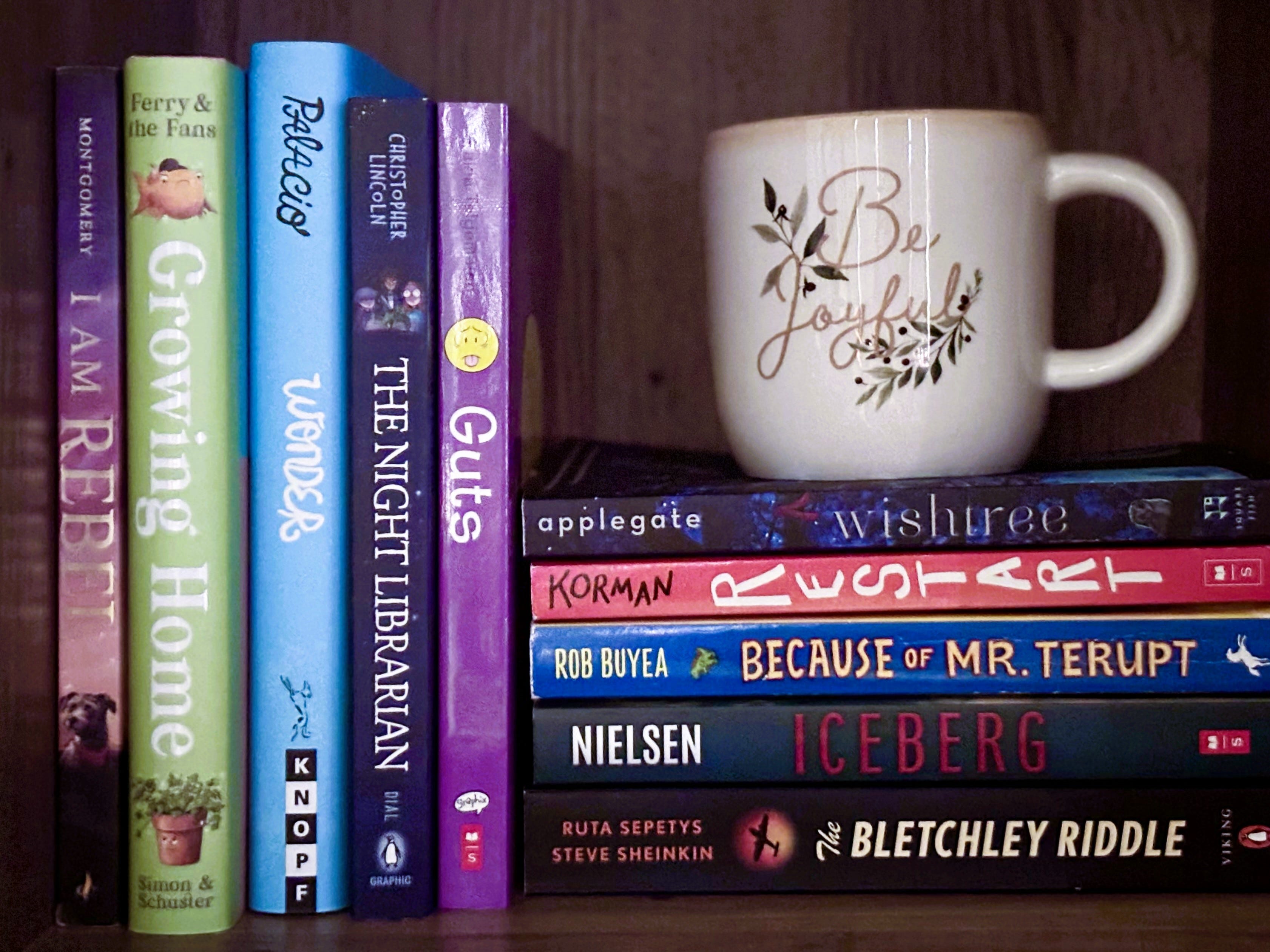
When my turn came, I randomly selected a bag that caught my attention. From it, I pulled a mug that read, “Be Joyful.”
My friend and I laughed, and that was the beginning of our joy project.
Years later, it continues. Every so often we send each other a quick text to share a simple joy, and this act has become a defining moment of my life.
Reading the back cover of books, stepping foot in a library, aimlessly wandering a bookshop, immersing myself in a good story– I sense peace and joy settling into the knotted fabric of my muscles when books are involved; books are defining aspects of my identity, too.
They offer me a sacred haven from a chaotic world. So, I couldn’t wait to help my daughter enter into this revered space of reading, too.
If you’ve been following my Substack (you can find past articles at The Visible Reader website), you know that desire didn’t unfold as planned; it’s been a messy process.
But, the sacred and the profane live side-by-side, so I have made peace that my reading journey with my daughter has been anything but perfect.
My Substack articles, then, aren’t supposed to be the answers to getting children to read; they’re just some potential entry points to helping children find their way into books.
And as I continue to explore ways to do that, the act of producing this Substack has become another item on my list of joys. I’m not entirely sure the purpose of this writing project, or where it is headed. I jokingly tell my family my Substack is my Noah’s Ark or my Field of Dreams– something tells me to write, I respond, and then I hope its purpose will be revealed.
In the meantime, I thought I’d tell you it’s okay if your family’s reading journey with your children doesn’t look like how people say it should.
Let’s aim for progress, not perfection, and let me show you what that looks like in my own family.
My daughter and I just finished a 300-page suspense novel that I eagerly gave her from a small independently owned bookstore I visit once or twice a year. This was back in September. On Dec. 3, I even posted on the Substack feed, “Joy=reading a suspense novel with my daughter on a week night in front of the fire on a cold December evening.”
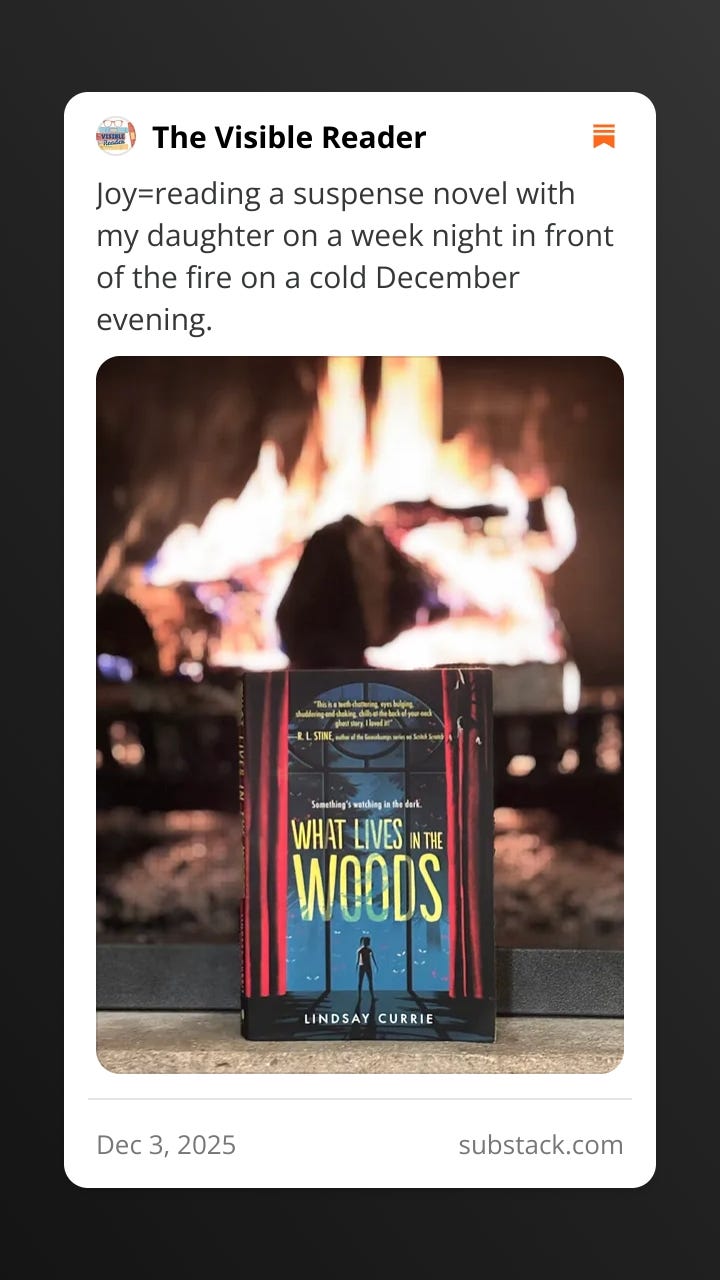
If you do the math, it took us approximately half a year to read this book aloud together. We liked it, so I can’t really explain why it took us so long to finish it except to confess that we read it inconsistently. Sometimes I’d read from it every night; other times, weeks would pass before we even thought to pick it up again. I suppose none of this really matters. We read a book together; we finished it. Should I be concerned it took us months to do so? Probably not.
It does reveal this, though: I purchase books– more than we actually consume– for my daughter that I think she would like because they sound intriguing to me, but oftentimes they are at the wrong level for her to read independently right now. As a result, my daughter picks up and puts down books more than I care to admit. I just secretly hope she’ll return to them again as she gets older.
To combat this level-of-difficulty issue, we have tried audio books. Sometimes she follows along in a physical book while she listens; other times she draws. And yes, even occasionally, she will be playing a mindless game on her tablet while she half-heartedly attends to the book as background noise. Ideal? Experts would say no.
In fact, let me be honest here. Screen time wins out in our household well beyond the recommended allotment. My daughter still gravitates toward the easy form of entertainment rather than a book.
Joyfully inviting my child to read each night frequently turns into a battle, too.
“Turn off the screen and pick up a book,” I roar from the kitchen as I scrub tiredly and frustratingly at a pan after dinner, time ticking down to our bedtime routine faster than I would like and still no reading has occurred.
So, given life’s demands, my child does not always read the recommended 20 minutes a night. Sometimes it’s only 10 minutes. On Friday and Saturday night, it might not be at all.
I have tried implementing a morning reading routine with daily devotionals as a New Year’s Resolution. Two months later, I’m still reading them— to myself; my daughter asked me to stop, and that came shortly after I attempted to force the issue on a morning we were already running late; we just made it to the school doors as the bell rang.
I still have several ideas on my brainstormed list of ways our family’s reading lives with my daughter is far from perfect, but I think I’ve made my point.
I’m not trying to undermine the other 34 articles I’ve posted on Substack since November. I’m just giving you permission to “take attendance” of the small ways reading shows up in your household even if it doesn’t look the way you think it should or you’ve been led to believe it should.
Every small victory is still a victory.
I actually began working on these articles because my daughter asked me how she could improve her writing.
“Well,” I thought to myself, “I used to study writing. I should model writing for her.”
I started publishing them, so she could see the messiness of the process— from brainstorming, drafting and writing to revising, editing and sharing with an authentic audience.
Shortly after, she began drafting her own suspense story. Over the months she’s been slowly working at it, I see her crafting sentences that suggest this student writer is also a reader.
Furthermore, she identifies as a reader, even occasionally wearing it branded on a beloved sweatshirt that reads “Book Girlie.”
Already in third grade, she’s been teased for professing a love of books. She came home to share this news with me one day, and I felt heartbreak mixed with fear.
“Would this be the end of her reading identity?” I wondered.
Thankfully, it wasn’t. She excitedly pointed out the comment from her teacher on her latest report card: “[She] is really proving to be quite the passionate reader.”
Even if she’s not a textbook definition of a consistent reader, the fact that she identifies as a reader has been the biggest victory for me in this process so far.
We haven’t mastered some perfect family plan to raise a reader, but we have still made reading a visible, vital and valued part of our routines– for the most part anyway.
My Substack’s tagline is “Restoring reading’s presence, power and purpose in our everyday lives.” No where in that alliteration does it include the word “perfection.”
A family reading routine doesn’t have to be perfect to be effective; it just has to exist.
Consistency would be great, but even if you aim for “mostly consistent some of the time,” you will earn an A for effort, and despite the grumbling that effort might bring, you will still see those small doses of joy that raising a reader can bring.
Let’s keep striving to make reading VISIBLE. VITAL. VALUED— together.
Thank you to my readers and to everyone who generously shared their time and expertise for interviews. While this is officially article #30, some pieces were part of a series, making this my 35th article on Substack since November. If you’ve been enjoying these articles, please help spread the word and encourage others to subscribe.